Introduction
Materials & Production
Airframe Performance
Avionics & Sensors
Sub Systems
Swing Role
Cost
Logistics Support
 Yet another factor separating Eurofighter Typhoon from the crowd is its avionics and sensors suite. This section outlines the systems and packages necessary for high mission effectiveness and survivability in the high threat situations the aircraft was designed to meet.
      Â
         Â
            The DASS is internally housed. It provides an all-round prioritised assessment of Air-to-Air and Air-to-Surface threats with fully automatic response to single or multiple threats; manual override is available. The DASS includes:
There is provision for future growth and modification to cater for changing threat profiles. The aircraft’s design complements the DASS by minimising Eurofighter Typhoon’s Radar and Infra-Red signature. (MIDS) The MIDS is a high capacity digital information distribution system allowing the secure and jam-resistant exchange of real-time data between a wide variety of users, including all the components of a tactical air force, and where appropriate, land and naval forces. The system will present a comprehensive tactical environment on the MHDDs, relieving the pilot of the need to assemble the necessary information from a large number of independent sources. It also ensures the pilot is aware of threat and friendly aircraft which are beyond the areas covered by Radar and Infra-Red Search and Track (IRST). To complement the Radar, a dual-mode Forward Looking Infra-Red (FLIR) sensor is mounted on the port side of the fuselage, forward of the windscreen. In the Air-to-Air role the sensor, integrated with the Radar, is used for passive detection and tracking of targets; this system is referred to as Infra-Red Search and Track (IRST).
The CAPTOR Radar has been developed by the Euroradar consortium. The multi-mode pulse-Doppler Radar is the first airborne Radar in NATO with three as opposed to two processing channels. The third channel is used in a jamming scenario for sidelobe nulling, interference blanking and jammer classification.
Sensor fusion is the processing of information received and transmitted by the key aircraft sensors. This information is presented clearly and accurately in an uncluttered fashion reducing pilot workload. The high level of integration and sharing of information between the various sub-systems gives the pilot an autonomous ability to assess rapidly the overall tactical situation and respond efficiently to identified threats.
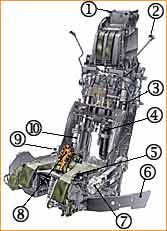
   Derived from the US Navy Mk.14 seat, the Mk.16A is some 30% lighter; this is achieved by combining the twin ejection gun outer cylinder tubes as both the propulsion system and the seat’s primary structure. The seat offers high comfort levels, and is integrated with an On-Board Oxygen Generation System (OBOGS), chemical defence, and communication systems. The narrow head box contributes to Eurofighter Typhoon’s excellent rear vision. The simplified combined harness allows unassisted strap-in, and the passive leg restraint system avoids the need for the pilot to wear restraining garters. A second generation electronic sequencer is incorporated. Reliability and maintainability are key elements of the design, with full access to in-cockpit components.
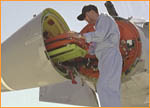
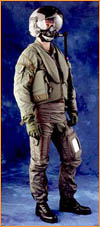
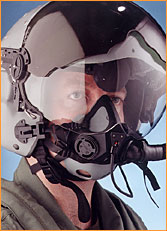
Normal access and exit from the cockpit may be via either an external or integral ladder. The latter, designed for autonomous operations, is a telescopic arrangement stowed in the port side of the fuselage below the cockpit; entry and exit is through a combination of the ladder, footrests and handholds. Emergency escape is by the Martin Baker Mk.16A ejection seat; the canopy is jettisoned by two rocket motors. To ensure that the pilot is physiologically compatible with Eurofighter Typhoon’s agile capability, the life support system provides pressure breathing and ‘g’-protection to the extent that ‘pilot-straining’ is not necessary under high ‘g’-force. All aircrew equipment is designed as an integral part of the weapon system. The AEA is unique to Eurofighter Typhoon and includes: Full-Cover Anti-‘G’ Trousers (FCAGTs) and Chest Counter-Pressure Garment (CCPG) Liquid conditioning garment Nuclear, Biological, Chemical (NBC) protection A lightweight Head Equipment Assembly (HEA) incorporating the HMSS, Night Vision Enhancement (NVE), and optical protection.
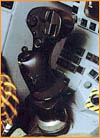
HOTAS controls allow the pilot to carry out complex tasks with relative ease during intense situations. There are some twenty-four finger tip functions related to:
DVI allows the pilot to activate non-safety critical moding and data entry functions as an alternative to using manual methods. Options include:
DVI commands are confirmed by visual and/or aural feedback. This unique VTAS capability drastically reduces the pilot’s workload enabling him to focus on the mission and systems operation. In an air battle scenario this system even allows the lead pilot to assign weapons to targets for both himself and his wingman with three simple voice commands. The HMSS provides flight reference data, an energy cue, and weapon aiming through the pilot’s visor; this will allow target acquisition and engagement at large off-boresight angles. The helmet also incorporates night vision aids using light intensification and provision for Forward Looking Infra-Red (FLIR) imagery.
The three full colour Multi-Function Head Down Displays (MHDDs) present a wide range of information including:
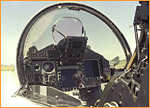
All available formats can be shown on any of the three MHDDs, with detailed information selected through the multi-function soft-keys arranged around each MHDD, by X/Y cursor control, or by DVI. The displays and controls interface with their respective systems via a Cockpit Interface Unit (CIU), Computer Symbol Generators (CSG), and databuses. For systems integrity, some controls are hardwired to individual systems. The number of conventional panel mounted controls and indicators has been reduced to a minimum. The main interaction between the pilot and the aircraft systems is via the Manual Data Entry (MDE) facility, the Head-Up Display (HUD), Multi-Function Head Down Displays (MHDDs), the Voice Throttle And Stick controls (VTAS), and by Direct Voice Input (DVI). The pilot has seven display surfaces available to him: the HUD, three MHDDs, a Helmet Mounted Symbology System (HMSS), a Dedicated Warning Panel (DWP), and a Multiple Information Distribution System (MIDS) display. Cockpit lighting is compatible with night vision enhancement, and daytime brightness of the displays is automatically adjusted. The advanced cockpit design and layout is based on an extensive series of formal assessments by operational pilots from the customers’ air forces, carried out in a rapid prototype facility.   Â
A high level of systems integration and automation has been adopted to allow safe and efficient single-seat operation in the swing-role environment. Unprecedented attention has been given to Man-Machine Interfaces (MMI). Advanced digital technology not only enhances operability and survivability, but also simplifies aircraft maintenance. Excellent all-round vision, head-up operation in all missions, and workload that is compatible with single-seat operation are the major principles of Eurofighter Typhoon’s high technology cockpit design. Â
   Â
 |
||||||||||||||||||||||||||||||||||||||||||||||||||||||||||||||||||||||||||||||||||||||||||||||||||||||||||||||||||||||||||||||||||||||||||||||||||||||||